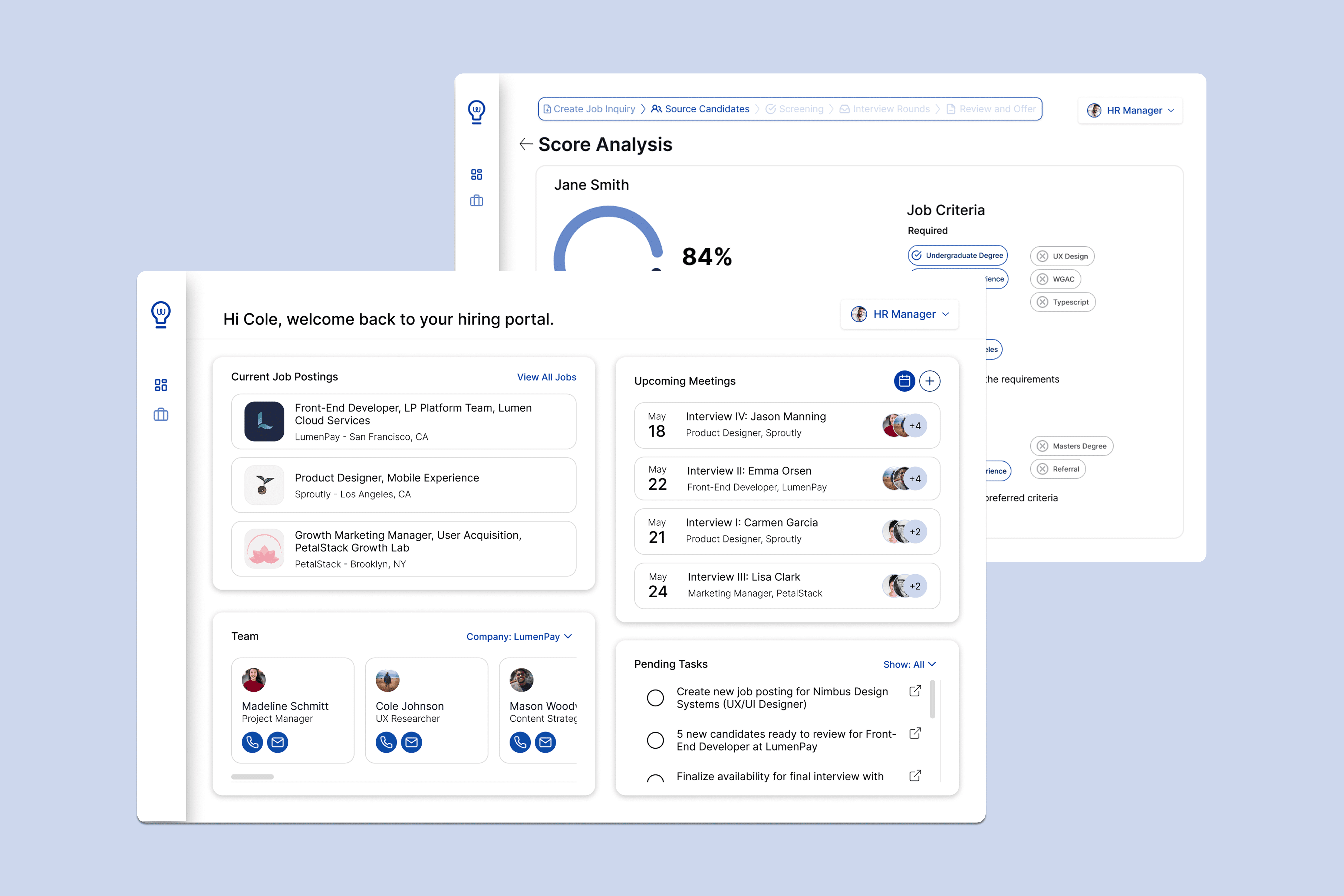
Context
Understanding the problem
Hiring Managers and recruiters lack efficiency and standardized tools to select, evaluate, and manage candidates' application status throughout the hiring process. Due to a large volume of candidates, recruiters need to effectively manage communication, screening, and tracking across numerous applicants.
Research
Listening to the people who hire
We interviewed 8 professionals across the hiring spectrum, from early-career recruiters to department heads.
Pain Points
Ideation
Exploring the solution space
User Flow
Mapping the hiring journey
Usability Testing
Testing assumptions before committing to pixels
We tested low-fidelity prototypes with recruiters and hiring managers to understand how users think before designing how they work.
Task given to participants
"Review candidate profiles and select one best-fit candidate to move to the interview stage."
Key Observations
Where users got stuck
No clear way to select candidates
Users had no way to move a candidate to "selected." The action lacked any visual affordance.
Dead-end on candidate profile
After opening a profile, users didn't know if they could select from there or had to go back.
Resume was non-negotiable
Both participants needed the full resume before evaluating. No summary was a substitute.
AI score lacked transparency
Users questioned what the score was based on. Trust required explainability.
Key Decisions
Making design decisions
Each finding from testing pointed to a design tradeoff. Here's what changed and why.
Design Details
Key interface decisions
Reflection
Process over tools
In the age of AI, spending time defining the problem and understanding context has become more valuable than time spent in Figma. Tools come and go, but strong foundations and solid process remain the same.